


Best of: The Top Dynamics 365 Highlights from the First Half of 2026
The first half of 2026 has shown just how rapidly Microsoft Dynamics 365 is evolving toward agent-driven, autonomous business processes. Instead of individual tools, a connected platform is increasingly taking shape, where AI agents actively collaborate, prepare decisions, and execute entire workflows independently. Since no new Microsoft announcements are scheduled for July and August, we’re taking a look back. From our monthly news updates, we’ve compiled the eight most significant Dynamics 365 highlights from the first six months of 2026—one top topic per solution.
Real-Time Financial Management Instead of Looking Back
With Dynamics 365 Finance, the focus for CFOs is clearly shifting away from purely retrospective analysis toward active, data-driven management in real time. New Copilot and Finance Agent features bring financial data directly into the operational context, whether in the ERP system, in Excel, or in Teams. This makes correlations, risks, and options for action immediately visible. Recurring tasks such as reconciliations, invoice processing, or variance analyses are increasingly automated and run in the background. At the same time, AI-powered analyses provide a solid basis for decision-making, for example, for liquidity planning or cost control. For finance leaders, this means a reduced operational burden and more room to react proactively to changes rather than waiting until the monthly close.
Smarter from Procurement to Delivery
Dynamics 365 Supply Chain Management is evolving into a fully interconnected, agent-based supply chain. New Agentic AI features support the entire process from procurement through warehouse operations to delivery. They identify bottlenecks early on, automate communication with suppliers, and help validate decisions more quickly. In addition, current real-world case studies demonstrate how modern demand forecasting, quality management, and the updated warehouse management module significantly simplify day-to-day operations in the supply chain. For companies, this results in a supply chain that not only reacts but also acts proactively—with greater transparency and higher resilience.
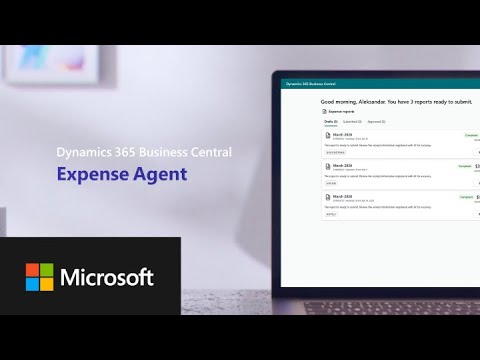
Automated Expense Processes with the Expense Agent
With the new Expense Agent, AI-powered expense management is making its debut in Dynamics 365 Business Central. The goal is to significantly simplify the entire process, from receipt to approval. The agent automatically captures receipts, extracts details such as amount, date, or category, and prepares expense reports so that employees usually only need to review and confirm the suggestions. The tight integration with Microsoft Copilot is particularly convenient. You can submit Expenses directly via the web app, Outlook, or—in the future—via Copilot as well. The result is less manual effort, greater compliance, and significantly more transparency in day-to-day financial operations.
Calculate Project Proposals with Confidence
With the new what-if analysis in Dynamics 365 Project Operations, project proposals can be planned with much greater confidence. Instead of laboriously testing assumptions in Excel, teams can simulate various scenarios directly within the system and see their effects immediately. Adjustments to prices, resources, or quantities are compared against one another in real time. The system automatically calculates key metrics such as revenue, costs, and margin without altering the actual proposal. For decision-makers, this means proposals are created faster, based on a more reliable data foundation, and risks or margin potential can be identified before a commitment is made.
Agentic Commerce as a New Gateway to the Retail Experience
Agentic Commerce is fundamentally changing how customers shop. Instead of clicking through menus, filters, and categories, they enter directly into a natural, AI-powered conversation. Intelligent shopping agents analyze contextual data, weigh options, and deliver tailored recommendations—an approach that is increasingly replacing the traditional way of entering a store. Those who rely on Dynamics 365 Commerce in combination with Microsoft Copilot create seamless, context-based customer experiences and influence purchasing decisions precisely at the moment of intent to buy. As a result, the shopping experience feels like personal advice rather than a mere product search.
Less admin, more actual selling
The biggest advancement in Dynamics 365 Sales right now comes from Agentic AI. Two new agents take the most time-consuming tasks off sales teams’ hands. The Data Entry Agent extracts unstructured information from emails, documents, or screenshots and automatically transfers the relevant data to the CRM. The Data Exploration Agent, in turn, answers analytical questions in natural language and immediately displays opportunities, trends, or pipeline risks in clear visualizations. The result: fewer clicks, less searching, faster decisions, and more time for what really matters: customer conversations, relationship building, and closing deals.
Quality Assurance in Customer Service Reimagined
With the new Quality Evaluation Agent, Dynamics 365 Customer Service takes service quality to a new level. The agent automatically analyzes closed cases and entire customer conversations. It evaluates each interaction against defined quality criteria and highlights where processes are already working well and where there is still room for improvement. For service managers, this means fewer manual reviews, but more objective transparency and faster improvement cycles. Future enhancements—such as multilingual evaluations, criteria versioning, and simulations—are designed to make the agent even more powerful—a clear productivity gain for anyone who wants to ensure service quality in a scalable and consistent manner.
Smarter Contact Center Operations Thanks to Service Operations Agent
With Dynamics 365 Contact Center, the focus is increasingly shifting from just customer interaction to the operations themselves. The new Service Operations Agent brings AI directly into administration and helps set up, optimize, and maintain stable contact center environments more quickly. Instead of manually maintaining complex configurations, admins can work in natural language—for example, to set up channels, define routing, or analyze errors—all within a central, -driven interface. In addition, a new screen recording feature provides deeper insights into real customer interactions, enabling service managers to identify specific areas for optimization. For companies, this means greater control, better service quality, and a contact center that dynamically adapts to increasing demands.
Conclusion: Agentic AI Shapes the First Half of the Year
Whether in finance, supply chain, sales, or customer service: the common thread running through the first half of 2026 is clear. AI agents are increasingly taking on operational tasks, relieving teams of routine work, and laying the groundwork for faster, more informed decisions. Those who capitalize on these developments early on will gain a clear competitive edge. Would you like to find out which of these innovations are particularly relevant to your company, or how you can effectively integrate Agentic AI into your Dynamics 365 processes? Contact us—we’d be happy to help you take the next step.


